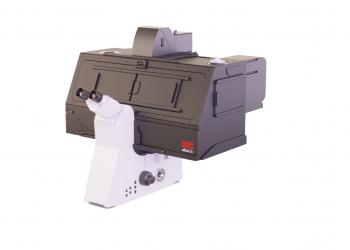
Nikon's Eclipse polarising microscopes are renowned for their ability to produce brighter, clearer and higher contrast images. The LV100NPOL, available in diascopic and episcopic illumination types, continues this tradition and offers a completely reengineered base for even easier operation. It also features an exclusive high-intensity halogen light source, which delivers brighter images, lower power consumption and less heat generation, thereby reducing the chance of heat-induced focus drift.
Diascopic (Transmitted) Light Source: The new high intensity 50W halogen light source incorporates a fly-eye design that outputs more light than a 100W lamp
Lead and Arsenic Free Objective Lenses
30mm Focusing Stroke
Reversed Centring Nosepiece: Up to five objectives, ranging from 4x to 100x can be mounted to the nosepiece and all five objectives are centrable
Bertrand Lens Incorporated into Design of Intermediate Tube
Rotatable Slider Type Analyser: The high precision slider-type analyser located in the intermediate tube is rotatable for a full 360°
Reduced Focus Drfit: Focus drift resulting from light source heat is greatly reduced by vitue of the lower power consumption and heat generated from the new diascopic light source
Diascopic and Episcopic Polarisation: Both Diascopic (transmitted) and Episcopic (reflected) polarisation observations are possible by mounting the LV-UEPI-N universal epi-illuminator
Episcopic DIC (Differential Interference Contrast): By mounting the LV-UEPI universal epi-illuminator and optional universal-type nosepiece and DIC accessories, including objectives, Episcopic DIC microscopy is possible
High Precision Rotating Stage: The stage is large-sized, pre-adjusted and click-stops in 45° increments, making it extremely accurate and easy to rotate
Diascopic and Episcopic Polarisation: Both Diascopic (transmitted) and Episcopic (reflected) polarisation observations are possible by mounting the LV-UEPI-N universal epi-illuminator
Vibration Resistant Stage: The large sized circular stage is supported near the optical axis and incorporates steel cross roller guides making the stage twice as stable and durable as conventional models.